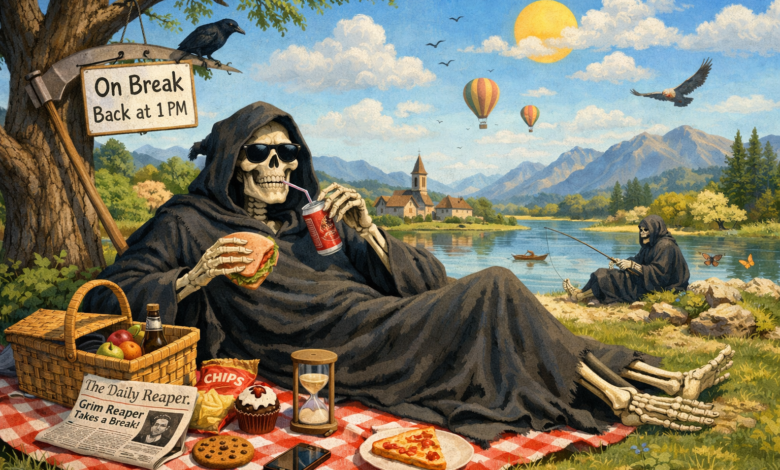
The day Death took a lunch break, no one noticed at first.
Ambulances still wailed. Hospitals still hummed. Old men still closed their eyes believing it was the end. But nothing finished. Hearts stalled and restarted. Bullets lodged but did not claim. The world hesitated, suspended between breaths, as if someone had forgotten to press send.
Elena noticed because her father sat up.
He had been dead for twelve years.
She was shelving books at the public library when the phone rang—her sister crying so hard the words tangled together.
Dad is awake.
Dad is asking for you.
Elena dropped the book. It hit the floor with a sound like a closing door.
Her father lay in the hospital bed exactly as he had the day she last saw him: gray at the temples, skin stretched thin by illness, eyes too bright for a dying man. The machines beeped nervously, confused by his refusal to obey.
“Elena,” he said, smiling. “You finally came.”
She did not hug him. She stood frozen, twelve years of practiced grief unraveling inside her chest.
“You died,” she whispered.
He frowned, as if that were a mild inconvenience. “I tried,” he said. “But something… stopped.”
Outside the room, nurses argued in hushed voices. Somewhere in the city, car accidents ended in apologies instead of funerals. Somewhere else, a woman stabbed her husband and both of them sat in shock, alive and bleeding.
And somewhere—Elena could feel it, like pressure behind her eyes—Death had stepped away from the desk, set down the ledger, and gone to eat.
Her father’s return cracked open a memory Elena had buried so deeply it had reshaped her life around the absence.
The night he died, they had fought.
She had been seventeen. Angry. Brilliant at cruelty the way only teenagers can be. He had told her she couldn’t leave town, couldn’t abandon her sick mother, couldn’t chase a future that didn’t include them.
“I wish you’d just die,” she had shouted.
He had stared at her then—really stared—as if memorizing her face. He died three days later.
Elena never left town. She took care of her mother until the end. She stayed small, careful, convinced that wanting more was dangerous. That words could kill.
Now the past sat upright in a hospital bed, breathing.
“Why are you scared of me?” her father asked gently.
She laughed, sharp and broken. “Because you’re not supposed to be here.”
“Neither are regrets,” he said. “But they come anyway.”
The words hit harder than any accusation.
Around the world, people began to realize what was happening. News anchors spoke of a global phenomenon. Religious leaders called it a test. Scientists called it impossible.
Elena called it punishment.
Because Death wasn’t gone forever. Everyone felt it—the ticking resuming, faint but inevitable. This was a pause, not a pardon.
A lunch break.
That evening, her father asked her to open the window. The sky outside glowed the color of old bruises.
“I don’t have long,” he said.
She swallowed. “How do you know?”
“I can feel the clock starting again.”
Silence stretched between them, heavy with everything unsaid.
“I didn’t mean it,” Elena finally said. “What I said that night.”
He smiled sadly. “I know. But you believed it enough to punish yourself all these years.”
Tears came then, violent and unstoppable. “I built my whole life around losing you.”
He reached for her hand. His grip was warm. Real.
“Then let losing me again set you free.”
When Death returned—no announcement, no thunder—things ended properly. Monitors flatlined. Bullets completed their journeys. Goodbyes were finished.
Elena held her father’s hand as it went slack.
This time, she did not feel guilt clawing at her throat. Only grief. Clean and sharp and honest.
And something else.
Permission.
Three months later, Elena left town.
She carried her father’s old watch, repaired and ticking steadily. A reminder not of death, but of pauses. Of moments when time bends just enough to let truth slip through.
She no longer believed words could kill.
But she believed they could save.
And somewhere, perhaps, Death finished lunch, glanced at the ledger, and smiled—because some souls don’t need to be taken.
They just need to be released.
Also Read: We Broke Up Over Something Small, But It Was Never Really Small